

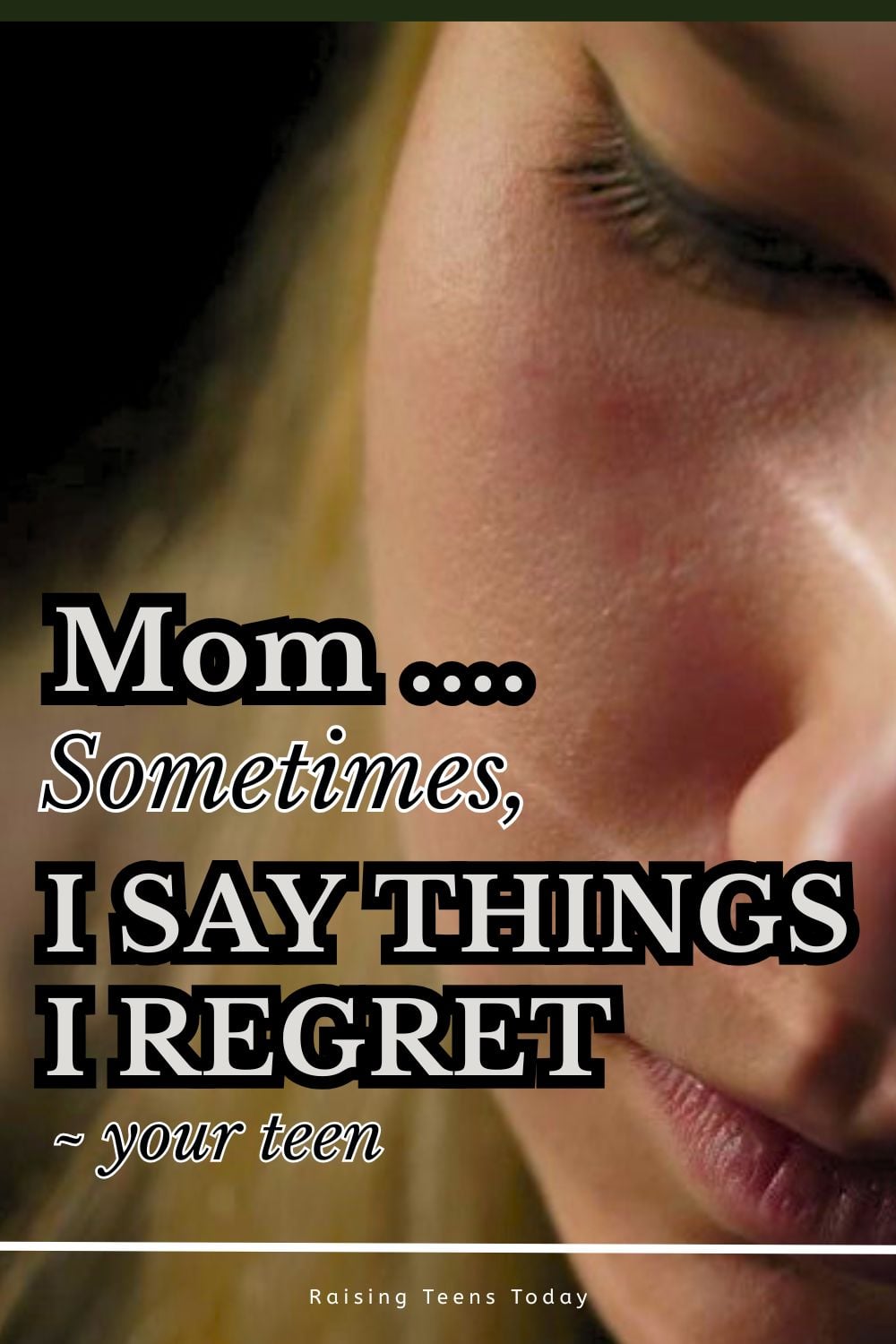
This Post: Mom… Sometimes, I Say Things I Regret
Written By: Nancy Reynolds
Mom,
Sometimes I say things I don’t mean.
Sometimes I say things I wish I could take back the second I say them.
And sometimes, the look on your face tells me just how much my words hurt you.
I’ll be in a bad mood, and I won’t know why. I’ll be rude, disrespectful, or mean to you sometimes, and I know you don’t deserve it. I don’t know why I say and do the things I do. It confuses me just as much as it confuses you. Most of the time, my words aren’t really about you at all… they’re about everything else going on in my mind and my life that I don’t know how to express.
~ Your Teen
Mom… Sometimes, I Say Things I Regret
Their moods, sass, and sharp tongues sure can sting, can’t they? But here’s what you need to know: Behind the eye rolls, sarcasm, and occasional outbursts is a teenager who’s still learning how to handle big emotions, and trust me on this… they need your help learning how to manage them.
I was chatting with one mom recently, who felt, first-hand, the harsh displacement of her son’s inner frustrations:
“My 15-year-old son walked through the door after school, kicked off his shoes, and barely said a word. Just a quiet “hey” as he grabbed a snack from the fridge, headed straight to his room, and closed the door. An hour later, I gently knocked on his bedroom door, popped my head in, and said, “Hey hon… when you get a sec, can you take out the garbage?” Suddenly, he exploded, and I became the enemy.”
“The nasty tone, the dramatic sigh, his sharp words (I’m pretty sure the neighbors heard), and the “Geeez, Moooom… why are you always nagging me?”
“It stung… in fact, it stung a lot,” she said. “But deep down, I knew… his attitude wasn’t really about taking out the garbage. I later learned it was more about the hard math test he bombed, his friend, who ignored him at lunch, and that his coach came down on him at practice for missing a pass. He’d been holding it all in, and home (with me) was the one place he felt safe enough to let it all spill out.”
I applaud this mom.
Dealing with your child’s pent-up frustrations, digging deeper for patience (especially when you have nothing left to give), and holding onto the perspective that “this isn’t about me” isn’t easy for any parent.
She could have unleashed on her son, yelled back at him, and grounded him for his attitude and disrespect. (Don’t misunderstand me, there ARE times you have to put consequences in place. You should never tolerate continued blatant disrespect.) But in this instance, her heart guided her differently.
She opted instead to exercise patience and dig deeper to unveil the “why,” and she subsequently realized that her son’s attitude wasn’t aimed at her at all, but rather a sheer release (and displacement) of the day’s frustrations.
Why DO Teens Lash Out: And, What Are They Really Trying to Say
Teenagers don’t always have the words to express what they’re feeling. In fact, they’re notorious for displacing their frustrations. So sometimes, when they lash out, they’re not trying to be disrespectful, push you away, or start a full-blown war; they’re actually asking for support and connection, the only way they know how.

10 Reasons Your Teen Might Lash Out
1. They’re Overwhelmed by Life
What it looks like: Heavy sighs, eye rolls, snarky comments, or a big attitude when you ask a simple question or make a request. “Ugh!! Can’t someone else take the dishes out of the dishwasher? Why do I have to do everything around here?”
What they really mean: “I’m stressed out. I have too much on my plate, and I don’t know how to handle it all. I’ve had a long day of being ‘on,’ and now I’m home safe, where I can finally release all my pent-up emotions.”
(NOTE: Life can feel overwhelming for a teenager, even if they don’t have a lot on their plate. A lot is going on behind the scenes in their brains and bodies that can make them feel overwhelmed and anxious.)
2. They Feel Misunderstood
What it looks like: Comments such as “You just don’t get it!” or “You never listen!” or “You’ll never understand!” accompanied by yelling or shutting down.
What they really mean: “I feel like you just don’t understand me or what I’m going through. I need you to stop what you’re doing and listen to me… really listen. I need my thoughts and feelings to be heard and validated.”
3. They’re Exhausted or Hungry
What it looks like: Irritability, irrational behavior/comments, outbursts over small things, being overly emotional, and (often tearful) meltdowns. (NOTE: Being tired or hungry can lower emotional tolerance fast.)
What they really mean: “I need food… now. I can’t keep up. I can’t do it all. I’m running on empty. I need to know you’re with me… I can’t do it alone.”
4. They Don’t Know How to Express Their Feelings
What it looks like: Heavy sighs, eye rolls, slammed doors, explosions over seemingly nothing, backtalk, anger.
What they really mean: “I’m feeling emotions I can’t even explain, and I’m frustrated and angry. I could use help trying to process all the thoughts and feelings I have swirling around in my head.”
5. They Feel Powerless
What it looks like: Pushing back, fighting you over things they want to control, like curfew, how they dress, or when they do their homework, for instance.
What they really mean: “You’re holding on too tight. I feel like you’re criticizing me (even when you have good intent). I need to feel like I have SOME control over my own life. Even if I fumble or make mistakes, I need you to let go a little.”
6. They’re Embarrassed or Ashamed
What it looks like: Getting defensive, blaming you for things that aren’t your fault, acting like you’re the reason they’re messing up.
What they really mean: “I messed up royally, I didn’t act responsibly, and I don’t want to fess up to what I did (or didn’t) say or do, so I’d rather blame you. One day, when I’m more mature, I’ll be able to admit my mistakes… just not today.”
7. They’re Testing Boundaries
What it looks like: Backtalk, arguing, challenging your rules, acting out.
What they really mean: “I’m a teenager. I’m going to push back like it’s my job. Don’t stop loving me just because I’m testing you.”
8. They Want Independence, But They Still Need You
What it looks like: “Leave me alone!” “I don’t want your advice!” Followed by “Can I have $20 for food?” or “Can you drive me to my friend’s house across town?”
What they really mean: “I’m growing up, and I need space, but I still need you. Don’t freak out if it feels like I’m pushing you away – I’m not. I’m just figuring out how to stand on my own two feet without you calling all the shots.”
9. They’re Afraid of Disappointing You (And/Or Scared About Their Future)
What it looks like: Lashing out first to avoid criticism, overreacting if/when you offer advice or guidance about decisions, or their future.
What they really mean: “I really am trying. But I feel like you’re putting too much pressure on me. I don’t know if I have what it takes. I’m scared you’ll stop being proud of me if I disappoint you or mess up.”
10. They’re Holding Onto Resentment
What it looks like: Snarky remarks, disrespect, passive-aggressive statements, and acting out.
What they really mean: “You really hurt me. You said some things that made me feel like I’m not measuring up in your eyes. I need you to make this right by apologizing and treating me with more respect moving forward.”

SIDE NOTE: Your Teen May Lash Out for Seemingly No Reason at All
Heads up, parents, there will be times your teen might lash out for what appears to be no reason at all.
-
- They’re in a bad mood… and they want company. It’s happened to me more times than I can count with my own kids. Misery loves company, and sometimes, when teens are in a crummy mood, they want everyone else around them to be in a crummy mood, too.
- Fluctuating hormones are wreaking havoc. One second, they’re fine; the next, they’re yelling at you because of the way you chew your toast. It’s not personal; it’s puberty.
- Behind the scenes, friend drama or social stress is hitting hard. A sassy tone or random blow-up at home might really be about something that happened at lunch, in the group chat, with their best friend, or on social media.
- They’re stuck in an internal conflict. Teenagers are constantly comparing themselves to others, worrying that they don’t measure up or fit in, or they’re just unsure of who they are. That inner turmoil can manifest as sarcasm, anger, or tears aimed at the people they love the most.
The Part You Don’t See, Parents
“Sometimes, I say things before I even understand what I’m feeling. My words come out all wrong – sharp instead of scared, rude instead of hurt, angry instead of anxious. And then, after I say those things I regret, I replay it all in my head. Here’s what you don’t see after our arguments…”
“The regret.
The second-guessing.
The wish that I could rewind the moment and try again.”
~ Your teen
Remember, parents, most teens haven’t yet learned how to apologize. Not because they don’t care, but because they don’t know how to verbalize or admit they were wrong without feeling ashamed. Saying “I’m sorry” is like admitting that they messed up. So, instead, they act normal… quite often, like nothing ever happened. While you’re stewing over the things they said, your teen has moved on.
Why You Shouldn’t Take It Personally (Even When It Feels Personal)
Here’s the BIGGEST truth of all, although the hardest to hear: Your teen feels the safest with YOU. Their words are often a reflection of what they’re feeling, not about you.
What they say:
“You don’t care.”
“You never listen.”
“I hate living hear.”
What they’re often trying to say is:
“I feel alone.”
“I feel like no one’s listening to me.”
“I wish I felt safer, and more valued and loved at home.”
There will be times you’ll get the worst version of your teen. Not because you deserve it, but because they trust you to still love them afterward. That doesn’t make it okay. But it does put it into perspective.
What Helps and How to Handle Things After an Argument
What lingers in your teen’s heart isn’t necessarily the argument itself; it’s what happens after.
They remember:
Whether you apologized for losing your cool.
Whether you listened when the heat of the argument was over.
Whether you even tried to talk calmly and focus on repairing your relationship.
Repair matters. A lot.
“That didn’t go well… want to try again?”
“I’m sorry. I think we both said things we didn’t mean.”
“Maybe I didn’t listen well enough. Help me understand what you were feeling.”
“I love you no matter what. Always remember that.”
What Your Teen Wishes You Knew
Mom,
When I say things I regret, I’m not trying to hurt you.
I still need you.
I still notice when you show up.
And I still care what you think, even when I act like I don’t.
Please don’t give up on me on my worst days. Those are the days I need you the most.
If you enjoyed this post, here are a few others you might enjoy:
Disciplining Your Teenager: 12 Logical Consequences That Work
Teach Your Teen How to Disagree Respectfully – A Powerful Life Skill
Help! I’m My Teen’s Emotional Punching Bag: 10 Ways to Nip It in the Bud
