

This post: “My Teacher Hates Me!” How to Help Your Teen Handle Teacher Drama and Grade Disputes
Co-Written By: Marybeth Bock and Nancy Reynolds
Your teen walks in the door after school, tosses their backpack on the floor, and storms off to their bedroom, followed immediately by the house-shaking vibration of a bedroom door slamming shut. You pause a minute, wondering what just happened, before heading to their bedroom and gently knocking on their door.
When you peek in, you see your teen staring at a letter grade on the online portal, like their world just came crashing in around them.
“Hey, hon… what’s going on?”
“Mom, I’m so upset! I studied SO hard for that test! My teacher completely hates me and grades my tests so much harder than everyone else’s!”
If you’ve lived through a scene like this, you’re far from alone. Nearly every parent will eventually hear “My teacher hates me!” from their teen.
“My Teacher Hates Me!” How to Help Your Teen Handle Teacher Drama and Grade Disputes
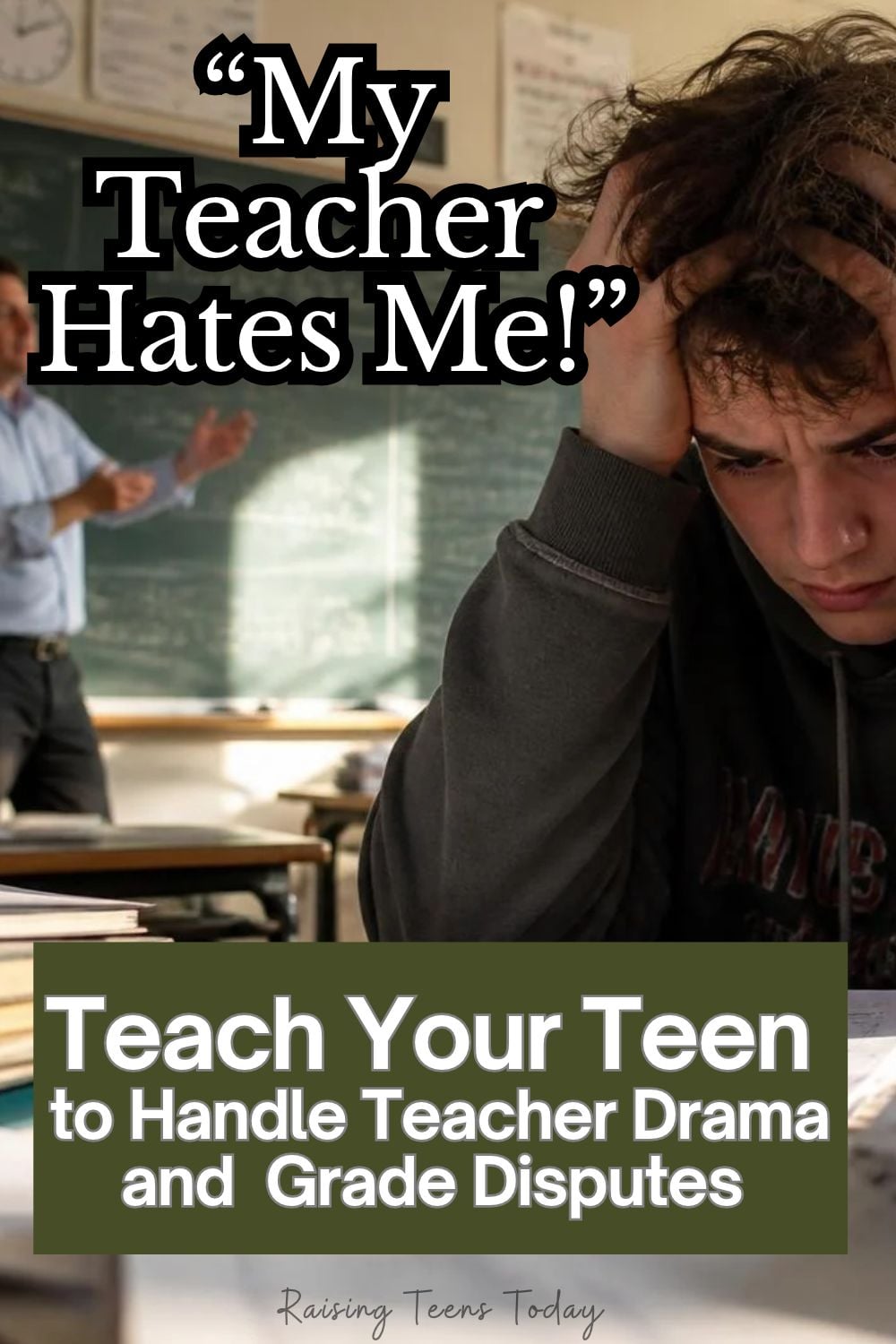
When your teen comes home upset about a grade, it’s easy for their emotions to take over.
They might feel frustrated, discouraged, or convinced their teacher isn’t being fair. And you know what? They may, in fact, have a valid reason to feel that way. Maybe the teacher’s expectations weren’t clear, the grading was unrealistically harsh, or the teacher actually is grading your child’s work differently. However, there may be another side to the story, too.
The point is, we can’t automatically assume our teen is making excuses, just as we can’t assume the teacher is in the wrong. Our job is to listen, ask questions, and help our teens sort through what happened so they can figure out the best way to move forward.
Here are five insightful steps to help you look past the drama, coach your teen through this emotional situation, and help them feel more in control at school.

STEP 1: Validate Their Feelings Without Assigning Blame
When our kids come to us and claim their teacher “has it out for them,” our protective instincts shift into high gear, don’t they, parents? It’s all too tempting to march into our teen’s classroom and have a “serious word” with their teacher.
But pediatric psychologist Dr. Vanessa Jensen of The Cleveland Clinic says that the crucial first step is to let your teen talk and validate their feelings without escalating the situation or taking sides. “The thing you don’t want to do is say, ‘Oh, she’s so mean!’ or ‘How could she say that to you?’ Sometimes, our kids just need a chance to complain and know that we care enough to listen.”
Instead, say something like: “I get it... It’s really discouraging to put so much effort into an assignment and end up with a grade you aren’t happy with. I understand why you’re frustrated.“
By validating their feelings, you lower their defenses and the “emotional temperature” in the room, leaving room to dive into objective information. Start by asking calm, inquisitive questions like:
“Which assignment pulled your grade down? Do you feel you studied hard enough?”
“Have you discussed your grade(s) with your teacher? What information/advice/explanation did he/she offer?”
“Have you missed any assignments, gotten any low quiz scores leading up to this, or are you having any trouble understanding the material?”
“Are you the only student struggling, or are others facing the same situation?”
The more information you can (non-judgmentally) gather, the better equipped you’ll be to understand the situation. Is this a personal attack, or is the teacher merely “teaching” and your child is frustrated because they’re not excelling in the class?
STEP 2: Delve Into the Truth: Personality Clash, Mismatched Style, or True Claim of Teacher “Favoritism”
We can’t deny that sometimes our teen’s claim of feeling “hated” by their teacher isn’t entirely fabricated. But when you dig deeper, you have more information to decide whether it’s true or merely a personality clash or a teaching style that doesn’t align with your child’s learning style.
We all know every teacher can be wildly different, both in temperament and teaching style. A teacher who is naturally direct, dry, or strict could easily put a sensitive or anxious student on the defensive. Your teen might perceive a teacher’s blunt feedback on a paper as being mean, when in reality, the teacher is simply critiquing the assignment objectively in his/her own way.
So, help your teenager step back and evaluate their teacher’s style objectively:
“Is this teacher tough on everyone, or do you feel singled out?”
“Did they explain why they took points off, or did you take a hard look at their feedback?”
Also, remind your teen to review the assignment rubric. It’s all too common for students to pour hours into a project, only to find they missed a few mandatory requirements on the grading rubric.

STEP 3: Teach Self-Advocacy (The Hardest Part)
We’re notorious for swooping in and fixing things, aren’t we, parents? It’s in our parenting DNA. But middle and especially high school is a runway to college and the workforce. The last thing we want to do is inadvertently cripple our teens by not teaching the vital importance of speaking up for themselves with confidence, respect, and authority.
Instead of you writing an email to the teacher, coach your teenager how to handle the conversation directly. If needed, offer them a script on what to say to their teacher. (The more you guide them in the beginning, the more confident they’ll become to handle issues that arise down the road.) “Hi Mrs. Davis, I was disappointed with my grade on the last test because I studied so hard. Could we take five minutes after class sometime this week to look over what I missed so I can do better on the next one?“
This simple approach completely changes the dynamic. It shifts the conversation from “Why’d you give me such a bad grade?” to collaborative “Let’s figure out how I can succeed.” More often than not, teachers are deeply impressed when a student speaks up and takes initiative, and misunderstandings can be cleared up quickly.
STEP 4: When and How You Should Step In
Of course, we should encourage our teens to fight their own academic battles, but when the situation can’t be resolved, or genuine red flags of unfairness are evident, we shouldn’t hesitate to step in.
Look for patterns rather than isolated complaints. If your teen notices repeated disproportionate grading compared to their classmates, or unprofessional, disrespectful comments directed specifically at them, it’s time to intervene.
When you do email or call a teacher, strive to avoid a controversial or accusatory tone, which will just instantly put the teacher on the defensive. Instead, aim for a partnership approach: “Hi Mrs. Davis, Trevor has been feeling a bit overwhelmed and discouraged about his progress in your class lately. We want to support him here at home. Could we exchange a few notes or set up a quick call on how he can get things back on track? We appreciate your time.“
Approaching teachers as allies produces far better results than approaching them as adversaries. Most teachers genuinely want to see their students succeed and appreciate parents who want to support their kids’ learning goals at home. If this approach doesn’t work, however, take your concerns to the department head or principal.
STEP 5: Focus on What You CAN Control
In the end, our teenagers need to learn one of life’s most important lessons: Not everyone will be fair, understanding, or easy to deal with, and learning how to handle that is simply part of growing up.
Our teens can’t force a strict teacher to be warm and fuzzy, and they can’t change the fact that a specific class requires a lot of memorization. What they can do is control how well they prepare or study, their willingness to learn outside the classroom with tutoring, their study habits, their ability to work with the teacher, not against them, and, mostly, their attitude. Little does your teen know that every difficult teacher or frustrating class is essentially training ground for the real, adult world.
Throughout their life, your teenager will work with difficult bosses, strict managers, and personalities they clash with. Learning how to handle a tough classroom situation now is building the emotional muscle and communication skills they’ll need down the road in college or in their career.
Grade drama is definitely exhausting, but it’s also a golden opportunity. By helping your teen avoid the “blame game,” take ownership, focus on problem-solving, and build resilience, you’ll be giving them a grade that truly matters – an A+ in growing up.
If you enjoyed reading “My Teacher Hates Me!” How to Help Your Teen Handle Teacher Drama, Grade Disputes and Classroom Conflict,” here are a few other posts you might like!
When Your Teen Hates School: 10 Tips to Motivate Them to Try
Mom, Here’s What I Really Need When I Walk in the Door After School
To The Mom Who Has a Few Years Left Before Her Teen Graduates
About Marybeth Bock:

Marybeth Bock, MPH, is a Mom to two young adults and one delightful hound dog. She has logged time as a military spouse, childbirth educator, college instructor, and freelance writer. She lives in Arizona and thoroughly enjoys research and writing – as long as iced coffee is involved. Her work can be found on numerous websites and in two books. Follow her on Facebook and Instagram.
